
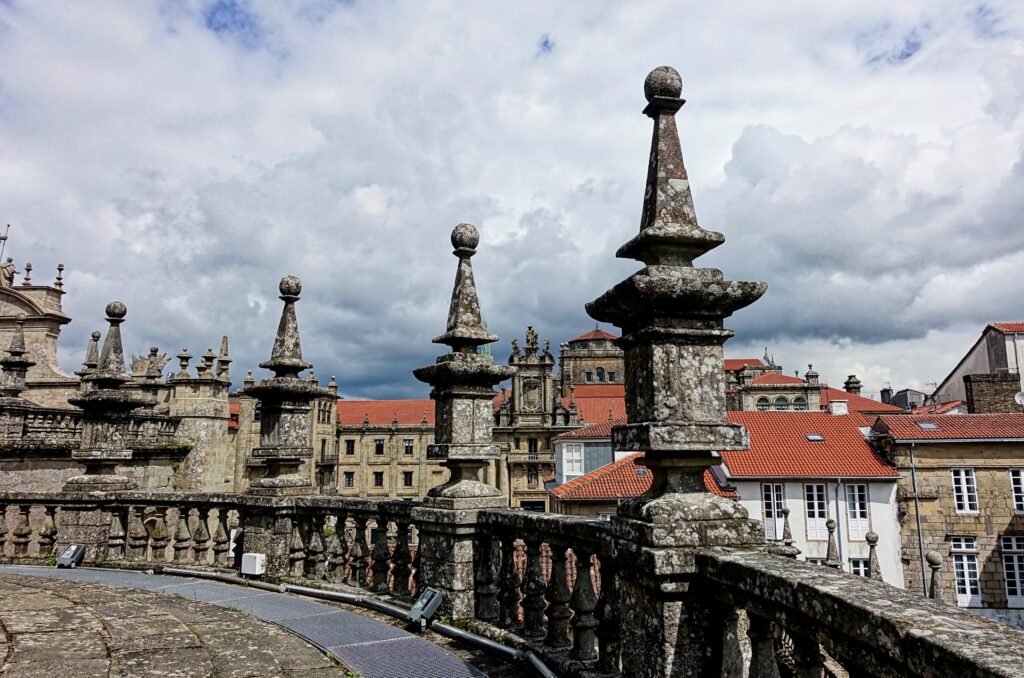
 Well, there we were in Vigo, Spain, of all places. Sir Francis Drake had been there, when in 1589 he and his English Armada sacked the place, burning and pillaging; this was only a year after their defeat of the Spanish Armada on behalf of Queen Elizabeth I. The globe-sailing privateer was a hero in England but notorious in Spain for being a pirate whose name, El Draque (“the Dragon”), sparked terror in the hearts of the victimized Vigoans. So, Gina and I weren’t sure our return to the Camino – this time on the Portuguese route – would kick off with that warm a welcome, given our English tongue and fact she hailed from San Francisco, a city which The Dragon himself claimed for his queen in 1579 after sailing into today’s Drakes Bay to repair his ship, the Golden Hind.
“If anyone Spanish asks, let’s just say we’re from California,” I suggested, in case there were any lingering hard feelings to greet us in Vigo. A flight to Madrid, a train into town: there we were, indeed, setting off again to trek the Camino to its end in Santiago de Compostela but this time without saving a kitten on the way. Could we? Could we travel the Portuguese route along coastal paths, through historic towns, and step our merry way past farmland, forests, and vineyards – all without being found, being targeted, by a helpless, homeless, abandoned cat that, like Camino, was determined to forge a better life for himself in San Fran….pardon me, California? Things were hard enough at the moment with kitty himself settled back home in Gina’s apartment, cared for by a doting house-sitter: how could we be on the Camino without Camino? This was his land, this Spain; these Vigo people were his people; how dare Gina and I laughingly believe we could trek for nearly two weeks and understand anything we see or experience without the Camino kitty as our guide? I imagined his look of disdain as he lazed all day in the sumptuous cat-bed placed in his favorite window, where the California sun liked to bake him into a stupor of spoiled well-being. Safe and loved, how quickly kitty forgot his origin story! Those two fool señoritas, I heard him saying, as Vigo welcomed us with its fishing-port air, sardine canneries, and promise of world-renown oysters, octopus, squid, cockles, clams, mussels, scallops, and other Galicia-region specialties. Like either one would ever gag down a cockle. “How gross,” Gina echoed when we, starved for lunch after our long train ride, perused the menus of every café within striking distance of our hotel and proved the Camino kitten correct. Without him along to make our adventures meaningful, if not comprehensible from his uniquely Spanish perspective, how would we even survive our way to Santiago with apparently nothing to eat but clams ‘n ham?
 After all, sleepaway camp in “Turkey” with Fatma and her family had done little to convert the kitten to an identity other than that of his birth – in Spain, on the Camino. As she eventually would say, “I give kitty all the best dishes – dönor kebab and kofte with lamb, you know? But he turn up his nose and say to me, Lady, I am no common Istanbul street cat. I am Señor Camino! And then he go climb curtain and not eat.” Fatma had a few exasperated words indeed for Candy and me when it was time for us to end our European trala and fly home – to first retrieve the kitten from Fatma’s temporary home in Geneva (she was a post-doc student at university there) and then board the KLM flight that would unite him, at last, and for good, with Gina. After four long months apart, his adoptive mom waited in San Francisco with a heart bursting with eagerness to welcome Señor Camino into her loving home.
Meanwhile, the evening we arrived at Fatma’s apartment, my sister and I were warmly invited to sit on the very sofa we had seen in a video call – velvety rich and sumptuous like a sultan would like, with gilded gewgaws for arms – and we were offered authentic Turkish coffee on a tray our gracious hostess placed beside the golden lamp we also had seen, as ornate as an Ottoman empire art piece. After nearly three weeks with Camino, Fatma insisted she had grown to love him – with reservations. She handed us each a tiny ceramic cup with its thick blob of scalding, black coffee and sighed to the depths of her Turkish soul. “He need strong mother, for discipline, you know?” She displayed her tender forearm, criss-crossed with the fine, bloody marks of Camino.
“Zorro,” I said with empathy.
“Ah, yes Zorro!” offered Fatma’s also marked husband from his seat on a chair hand-carved in the elaborate Persian fashion. “The Spanish fox!”
“Exactly,” I continued. “Kitty fancies himself a swashbuckling hero in the vein of the fictional vigilante who wears a mask, wields a cape, swings a sword with panache, and announces his presence by slashing a “Z” on whatever is handy. Like your arm.” As if to concur Camino, who had been sitting on the Turkish rug at our feet quietly listening, suddenly leapt – en garde! – and upended my tiny ceramic cup; black gunk spattered the sultan’s sumptuous sofa, and the saucer shattered on the gilded gewgaws.
“Camino, no! That is not okay!” Candy, leapt too; she chased the orange demon around the room, hissing threats in her best mother-of-teen-boys voice. Just wait until I catch you. Fatma, I supposed glad her cat-sitting assignment was at an end, smiled the exhausted smile of the brave, the stoic, and the survivor, and said the gunk could be cleaned up later. Candy eventually was successful in peeling Camino off the wooden objet d’art to which he clung with all the strength of his killer claws, and dropped the feline Zorro into Fatma’s beckoning but sure-to-scar arms. Her feelings for kitty were complicated. Weeping sweetly, she squeezed him to her long-suffering heart.
 “I will miss you so much, my naughty little kedicik,” she said between sniffs. “And remember, if you ever find California too boring for an hombre as handsome and suave as you, you can come live in Istanbul with us. We love you!” She smooched his finely chiseled forehead, leaving a lipstick kiss.
Camino clearly had worked his kittenish voodoo on his sleepaway camp family, for even seven-year-old Eren and his dad seemed as attached to him as Fatma appeared. When it was time to zip kitty into the flight-approved carrier that would hold him until San Francisco – for almost 20 hours straight – all three bid so long, farewell, adieu, goodbye as if he were going off to war or the New World on a perilous journey of uncertain outcome and they, his family, would be left behind, bereft.
Eren burst into tears when Candy and I carried him out the door, and his parents stood arm-in-arm waving, their shaky smiles saying don’t forget us. Camino himself – at attention in the carrier like go, go, go, let’s get out of here! – nonetheless wore his new, handwoven Turkish collar with pride if not panache and stood with a certain dash upon the equally colorful Turkish blanket with which his camp family sent him off.
And now, here in Vigo, Gina was asking: “Why do you suppose Minos fights me so, whenever I try to remove that collar the Turkish people put on him?” “Minos” (with a Spanish accent) was the affectionate diminutive Gina had given to her new housemate and baby; since his arrival she was sometimes challenged to understand his perplexing personality. First Spain, then France, then Switzerland, then Turkish camp – the countries and cultures the kitten had experienced in his first four (impressionable) months of life had left him as richly textured as his collar; full of all the mysteries and contradictions that the Camino itself embodied, with its centuries-old history and aura of spiritual significance, Camino the cat seemed to Gina to be, well, different than the other housecats she had known and loved in her life.
“Well, “I said, “being born on the Camino from generations of cats presumably also born on the Camino for centuries stretching back perhaps to the ninth, when the Camino itself was begun, Minos is not your basic cat.” I added what I had read on the Living Philosophy website once, that the Camino de Santiago is considered more than a simple pilgrimage: it’s a thing – an ancient tapestry of myths and legends that are central to not only the Spanish identity, but also to the entire Medieval European identity. “His feelings about the Turkish collar might be complex. Can you just let him keep it until he’s ready to let it go?”
Cuttlefish in their own ink. Galician-style octopus. Conger eel. Our lunch options were so frightening that Gina was briefly detoured from worry about Camino’s well-being onto the alternate route of wanting to solve our upcoming dining problems. The next day we were to trek to the town of Redondela, where Camino might rejoice in remembering his roots by stuffing himself with its stuffed-squid chef’s specials, but where we people-of-the-salad would suffer.
“Here’s the question,” she said, as we slogged around Vigo in search – in vain – for a fresh-foods market: “Is it going to be harder to walk the Camino wondering what to do with a sick, three-week-old kitten we picked-up, or walk the Camino and not eat – at all?” Oh yes, like I could see it: Gina and I, modern Medieval pilgrims trekking to Santiago – in prayer and in penance – while fasting.
“Maybe there will be another abandoned kitten we’ll have to rescue,” I said in defeat, relief, and low blood sugar. “Then we can head home early and not have to succumb to cuttlefish…or nothing.”
“And I can be with Minos!” Gina’s words certainly said it: it would be a long, hard, hungry Camino now that we would walk to Santiago without the company of the Camino kitty.
Recent Comments