
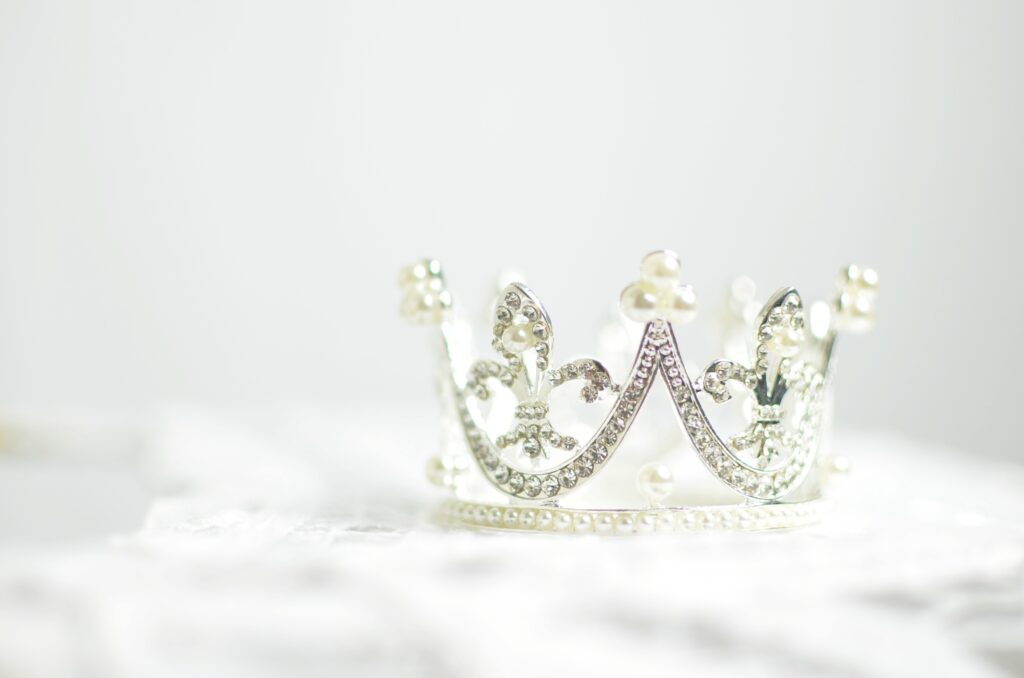
 The thing about being a baroness like, say, Noémie de Rothschild, is that one winter you can think, man, I am so sick of St. Moritz for who knows what capricious reason and the next find yourself founder of your own upscale Alps resort. In 1921 this French baroness was so over the scene at the swankiest ski resort of the day that she opened a luxury hotel in the smaller Auvergne-Rhône-Alpes region of southeastern France – a region the rich Rothschilds thought more marvelous. Quickly the copycat aristocrats who believed whatever was better for the baroness was absolutely better for themselves joined her by wintering there instead. Today, Noémie’s caprice is Megève, a storybook resort of rustic-chic chalets, cobbled, medieval streets, and, so no one gets homesick for St. Moritz, tony hotels and high-end boutiques.
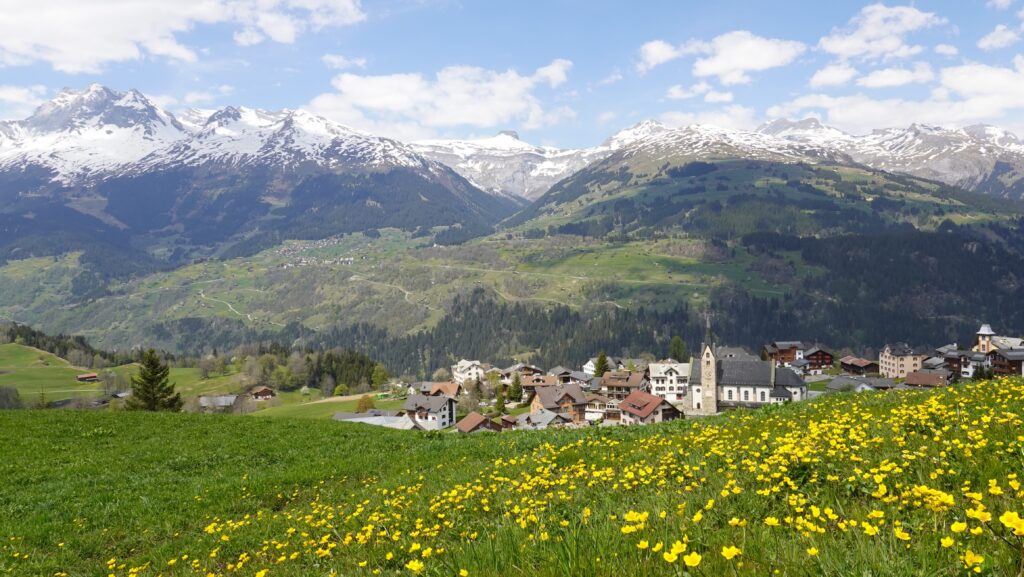
“Wow,” went Jacqueline when we cruised into town. “Nice.” Nice because man, I am so sick of sitting, I thought, child-locked in the Fiat’s backseat, and nice because the clean, cute, compact place looked so very storybook for its walkable wonders. Come-hither hills abloom in wildflowers; curving, car-free avenues lined with lit shop windows; and people who might have been the baroness’s friends – less serious than the Chamonix-ers but just as sporty – jauntily moving around with peppy, athletic auras.
“Let’s get out and do some hills!” I suggested. The drive from Chamonix had not been hairy or scary at all, so surely Camille would be eager to seek some thrills. Megève at first sight did not seem to be of the paragliding-ice climbing-chute skiing genre, however, so it was a bit of a hard sell to get my sister out of the car and into the…well, scene. “If you don’t want to promenade past the Dior and Chanel boutiques, there are spa treatments at the Beauty Farm.”
“Oh, and pay to have a French stranger touch me? No, thank you.”
“What about a stroll through art galleries, or the Megève Museum? There’s even the church of Saint-Jean Baptiste. That could be something to see.” I considered putting forth the idea of hot-air balloon ride, but that was more verboten heights, and really, I well knew if Camille couldn’t imagine herself doing the local Luge 4S (in winter) or hike-scramble-swim-rappel and thereby canyon in the Belle au Bois gorge (summer), our Megève “adventure” was destined for dullness. Still, I had come to Europe to walk, and walk I absolutely must. I mean, how bad would it be, on the official Camino de Santiago, not to? What befell trekkers who either chose or succumbed to alternatives, like taxis, buses, shuttles, or hitchhikes between nightly alber-goos, thanks to fatigue, injury, or a total loss of esprit? While we tooled to and fro around Megève in search of le parking, I checked-in with the trekkers themselves to find out.
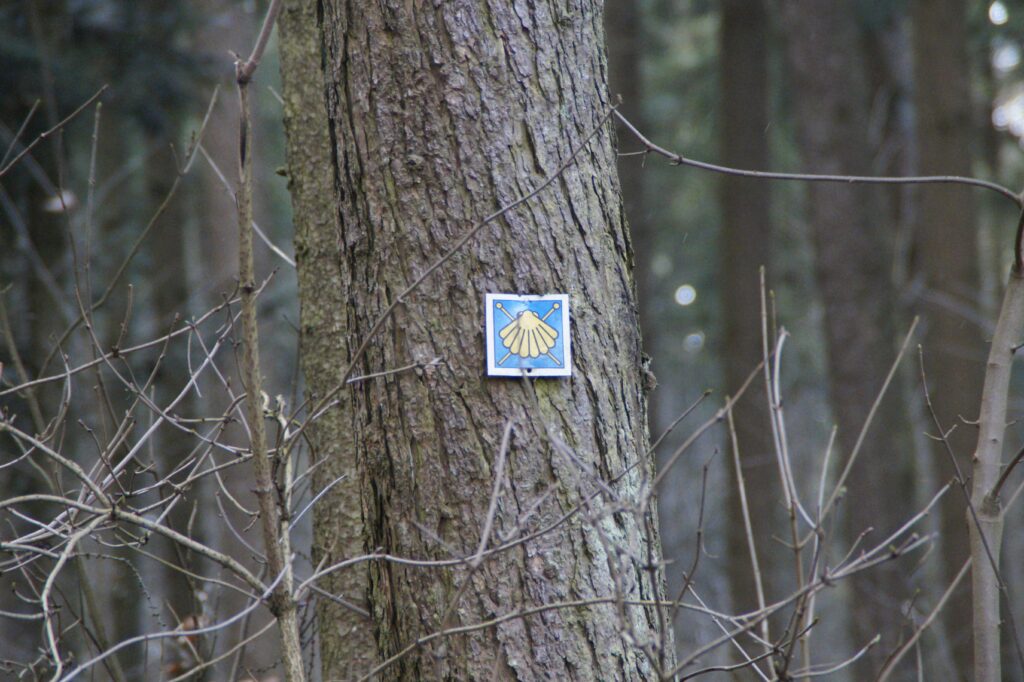 Taxi whore. Angela Leslee, for one, is most unforgiving of herself for even yearning – aching – to hop into a cab in Burgos, where her “traitorous big toe” torments her with pain. Oh, the shame! “I fancied myself a true pilgrim,” she says when almost giving in, “whatever the hell that is.” Meanwhile, Bill Bennett, also on his way to Burgos and possibly high on “saturation doses” of Ibuprofen for his knee issues, talks to himself, a new mantra with each footfall: “I don’t really need an ambulance. I want to finish the Camino happy and healthy. I don’t really need an ambulance. I want to finish the Camino happy and healthy.” However, when a bus arrives out of the mist and the driver beckons him aboard, Bill meets a moment that tests whether or not he, like Angela, is a true pilgrim. “My mind began to wander into dangerous territory,” he recalls the day Satan in the guise of public transport came for him. “That bus isn’t such a silly idea, Bill,” he thought, weakening. But then: a burst of renewed strength. Dammit, he decided and added new words to his mantra, “I am going to walk the Camino not bus the Camino.” Even Carolyn Gillespie sees the disgrace some trekkers feel when their true pilgrimhood is compromised. In her alber-goo dorm in Logroño, she meets a retired couple from Minnesota “kitted out in high-tech gear,” with the wife also sporting a compression sock on one foot and a bandage on the other. “He told me,” Carolyn remembers, that his wife “is not in shape and fell on gravel coming down from Alto del Perdon, and now has a sprained ankle and,” in the biggest trail indignity to date, “we’ve had to take the bus since then.” Carolyn shrinks from the shame of this, hoping she will never come to suffer such embarrassment, yet sends her heart out to the injured party. She remembers with sympathy: “He gestured at his wife, talking about her as if she wasn’t there.”
W. Lee Nichols takes the more philosophical view of the many Camino peregrinos who don’t finish the 500-mile walk in an actual walk. Speaking as one who, on the outskirts of Logroño, discovered a new shooting pain in his right hip, a stab that was “so intense I had to stop about every 50 yards and lie down,” he generously shares his wisdom: “For anyone who takes a bus or train to an airport for evacuation home,” he reflects, “their journey ends in disappointment – not, as hoped, a pilgrimage across a land of myth, mystery, history, and self-discovery.”
Well, I came to France to walk the Camino, not to sit the Camino. Road-tripping with my sister – for all its happy, laughing moments – is making me no better than a taxi whore, a bus embarrassment…a trek reject! If I didn’t get back out there, at least out of the car for a slow-peoples’ amble around lovely Megève, then would my Camino even count? Or, could I still be a pilgrim, even if a poor one? I mean, really: Even Bill Bennett wrestles with this question. There he is, trekking through Logroño feeling, he describes, “a certain irritation at seeing grossly overweight exercisers dressed in snappy tracksuits passing me. Especially with their pets,” he adds. “I took umbrage at being passed by a strutting Chihuahua.” To reclaim dignity in the pokey pace his pain-filled body parts had established for him, he imagines himself an ocean liner, “stately and majestic, slowing steaming towards my noble destination of Santiago.” Yet later in O Cebreiro he is overtaken by something more shocking than even a Chihuahua: In his words, “The Brazilian Cavalry.” Fifteen to 20 equestrians,
 impeccably attired in their britches and shiny knee-length boots. The women wore scarves and gold bracelets, and the men had Prada or Gucci sunglasses and sported Tag Heuer or Maurice Lacroix watches. Their hand-tooled leather saddles were works of art, and their horses must have been well fed because they pooped huge dollops of manure everywhere and often.
These tan, beautiful, pain-free equestrinos, who stopped frequently for wine they imbibed from large wine goblets, “exuded the lolling laziness of the incredibly rich.” The Brazilian Cavalry created a problem for Bill. “How should I regard them?” he wants to know. “As genuine pilgrims? So what if they were on horses? So what if they ordered expensive wines for lunch? All that mattered,” he comes to understand, “was what was in their hearts, and given there was no way I could determine that, I had to regard them like I’d regard any other pilgrim.” That is to say, without judgment, without envy, and hey, maybe even with cheer: perhaps one of the “beautiful, dark-haired women who glided past on their high mounts” would with her “haughty smile” and the snap of her riding crop offer him a hop up.
“Let’s get going,” said Camille after quickly gulping the coffee we stopped for four minutes into our amble around town. Megève was stunning. A colossal Christmas tree was going up in the main square, with its dazzling lights destined to awe holiday visitors charmed by Baroness Noémie’s fantasy made real of an Alps wonderland where the pretty people could play. It’s not like we weren’t welcome (see, Lake Como), for Megève would have liked nothing more than to woo us into Dior, to seduce us into a sweet, little ski day through the trees at Mont d’Arbois, or pamper us après-ski at the Four Seasons, their vin chaud scented surely with world class star anise and brandy. Alas, it was November: too early. Compared to the threat of a spa massage, to be endured while naked, a return car ride to Chamonix seemed to Camille to be the only possible event worth pursuing this day of Megève, so sit – not walk – I would until some vague future date. In the end, honestly: who gets to be the most authentic Camino pilgrim? Is the one confined in a Fiat’s child-locked back seat so very different from the tan, glossy, and possibly sauced one riding a horse – all of us traveling through lands of myth, mystery, history, and self-discovery? I think not.
“I really miss Camino.” My sister spoke for us all. Kitty waiting for us in our Chamonix flat, as well as 300 channels and snack-sacks of Cheez-Its, became the agreed-upon plan.
Recent Comments