
 Australian film director Bill Bennett was walking the Camino for reasons he could not fathom. “I had no idea why I was doing it,” he notes in The Way, My Way, his after-action report debriefing the 30-plus days he and his companion, the “Triumvirate of Pain” (knee, heel, shin), trekked across Spain and confronted his character shortcomings, the meaning of life, and, in the vein of apparently everyone else on the trail, fellow trekkers who drove him nuts. “I had been to Spain with my wife two years earlier and seen desultory pilgrims walking along various dusty trails following the Camino. It seemed such a futile and meaningless thing to do that it immediately appealed to me.
“All I knew was that I had to do it.” Bill’s having to do it introduced him to such Life Lessons as fellow pilgrim Pete, whom he assumed was an aging rock star. Actually, he remembers, “the aging rock star I’d revised down to a roadie. He didn’t seem to have the spark or panache of a rock star. And if truth be told, he seemed a little dumb. Lifting amps into the backs of trucks seemed more his thing.” When truth was told, Pete turned out to be a former Emeritus Professor at a prestigious American university. “The Camino had just coldcocked me again!” Bill exclaims of becoming newly aware of his tendency to judge. “This damn Camino is like a psychiatrist’s couch.”
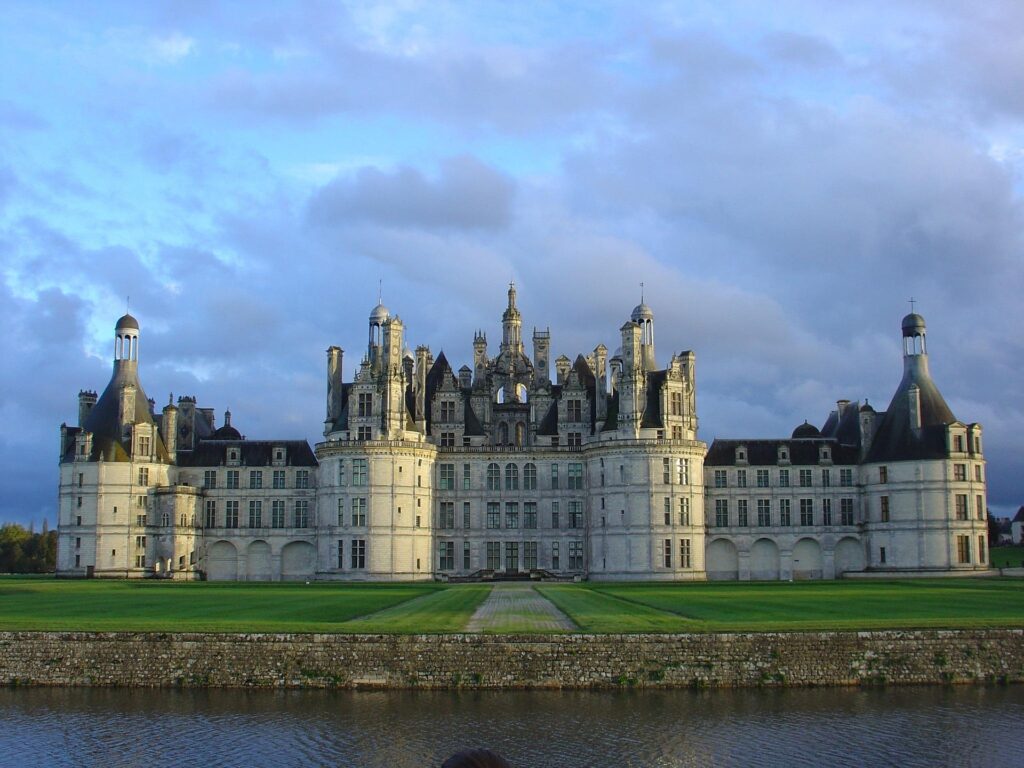
So, Bill’s trials were on my mind as Karen and I considered the da Vinci-inspired, double revolution staircase that King François the First in 1519 put in his Loire Valley palace to crow before other European sovereigns of his power. His sense of French Renaissance style was also on display to wow the world of his day, and from Louis XIV in the 1700s, who quite liked parquet floors, to the Mona Lisa in WWII, who hid out here to escape the Nazis, François I’s impressive place – aka the château Chambord – has been nothing if not important.
“Well, okay, it’s nice, I guess.” Karen’s level of enthusiasm matched my own.
“I guess.”
Here we were in yet another French spectacle. Chambord’s 4,500 works of art, 440 rooms, 365 chimneys, 84 staircases, and 13,500 acres of walled, enclosed park (the same area as Paris proper) tempted us to take-in all the gorgeousness, when, really, like Bill, our own Triumvirate of Pain (overwhelm, exhaustion, hunger) was coldcocking us almost semi-conscious.
The Loire châteaux were becoming a blur. Blois, Villandry, Cheverny, Chaumont-sur-Loire, du Rivau, d’Azay-le-Rideau: each, nay, all, were asking us to awe and marvel and learn; we were to admire and appreciate – we were to retain! – details of the rich, vivid history of France we were so lucky to see. We shuffled along another thousand miles in a small herd of tourists to ahh over (remember to retain!) another of Chambord’s 800 salamander symbols featured as King Francis’s personal thing.
 “I just don’t think I can keep walking.” At the moment there were no truer words than Karen’s Bill-ism. We were in the Loire Valley, but we may as well have been on the Camino breakfasting with the Australian director, the British lady “dressed like she was about to meet the Queen,” and her husband, who, in Bill’s words, “looked like he should be out hunting foxes with a pack of baying hounds.” Over their buffet plates piled with tall “leaning towers of Pisa” made of mini croissants – Way trekkers are typically ravenous – the couple asked Bill if he had walked the entire way to where they were, Santo Domingo de la Calzada, which is 137 miles by bus from the Camino’s start in Saint Jean Pied de Port. Of course! he replied. Feeling that his appearance surely “contained the hollow-eyed desperation of a shipwreck survivor” despite his surface cheer, Bill was flattered when the wife exclaimed, “There you are! You’re a true pilgrim.” What a true Camino pilgrim was, Bill had heard from one walker he, in a common Camino experience, was trying to avoid for whatever reason (too chatty or quiet, too slow or fast, too whiney), was one who endured. “If you finish the Camino,” she had said to him one alber-goo night he spent nursing a debilitating blister, “you’ll go to the highest place in heaven, because you are suffering more than any of us.” After making quick business of her croissants, pinky projected, the Queen-worthy woman then admitted, ‘We’re not. We’re not true pilgrims.’”
We only stay in the best places, she said.
Karen and I – we, too, stayed in the best places. Château de Perreux outside Amboise, with its troglodytic first floor carved into rock; Château d’Artigny in Montbazon, where perfume magnate François Coty once lived in sumptuous style; and Fleur de Loire Spa Hotel in Blois, which was once King Louis XIII’s brother’s grandiose place.
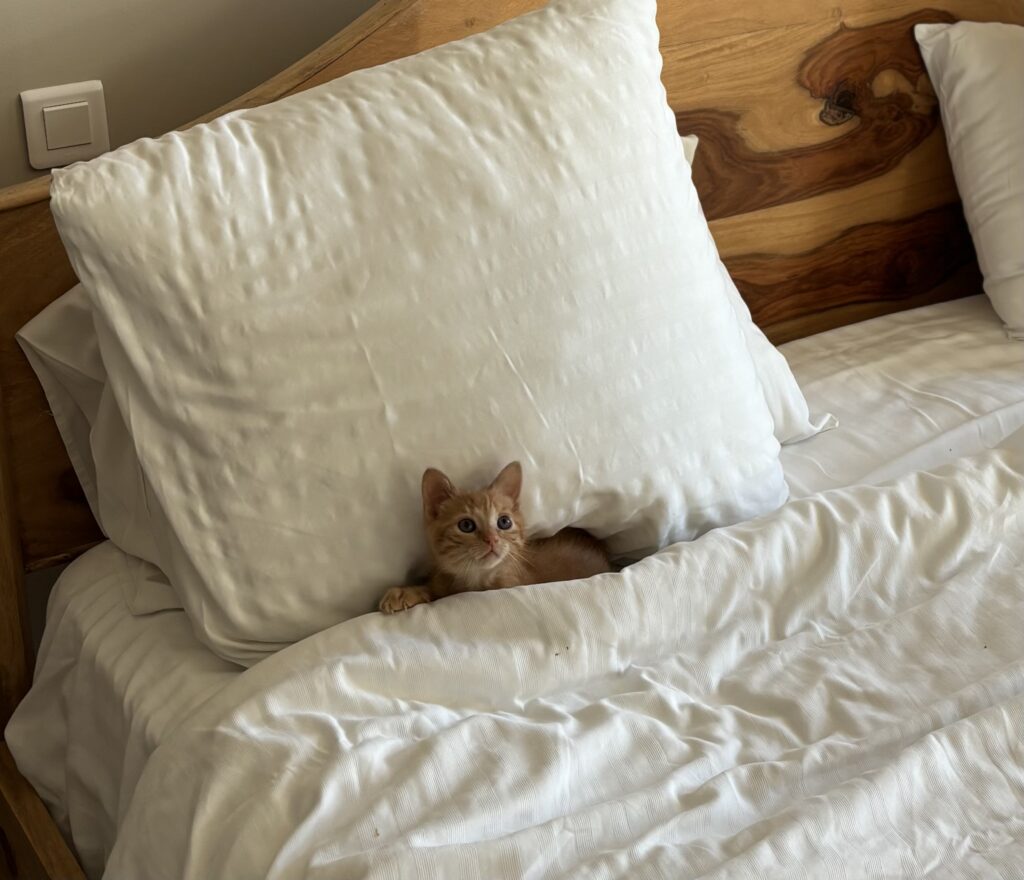
“Let’s go home to Camino!” Karen was over the salamanders. I, too, was thinking of kitty in his spa-hotel room, where spa-hotel staff had specially welcomed him with gilt-rimmed food dishes, a grand dog bed, and a luxury litter box whose fine-grain French sand satisfied his sense of pleasure.
“Do you miss him?” Here was our choice: cuddling with Camino or ogling the royal bedchambers and going all awe over Botticelli’s Virgin Mary, Infant Christ, and the Young St. John the Baptist, as we would soon do in the château Chambord. Does going the cat way as opposed to the “suffering” way mean that the Camino I was walking – albeit currently off-piste, as it were – was less than a True Pilgrim experience? If I were to arrive in Santiago by way of the Loire Valley – well-rested, well-fed, and spa fresh – would my Camino not count? As Bill puts it: “Is the person who carries a heavy cross on his back and crawls on his knees all the way from his front door in St. Petersburg to Santiago, is that person more a True Pilgrim than someone who gets off a bus and walks the last 100kms with a tour group?
 “What about the person who rides a mule, as against the one who rides a mountain bike? What about someone who walks the whole way listing to rap music on their iPod, compared to someone who walks with a vow of silence, or saying their Rosary the whole way?”
That’s right! And like centuries ago, when wealthy merchants, heads of state, and church leaders traveled the Camino on horses or in carriages (some would even be carried in palanquins by bearers) and overnighted not in alber-goos, but instead in palaces and castles, I did not need to suffer to be a true Camino pilgrim. It was not more holy and heaven-approved for Karen and I to trudge the million parquet-and-marble miles to go before we slept, on our feet, before a Botticelli.
“Yes, I miss him!” slurred Karen from the stupor we shared after overindulging – obviously – in châteaux. I did, too.
I could be all about the cat.
Recent Comments