
 Village chapels, grand cathedrals, and on the “French Way” alone, at least 51 churches: the religious significance of the Camino de Santiago is obvious to every pilgrim whether a believer or not. Add ancient monasteries like that of San Julián, the oldest in Spain and inhabited by monks for 1,500 years including today, and not even a trekker like Bill Bennett gets to Santiago de Compostela and the remains of Saint James without questions. As he says of why he felt compelled to undertake the Way: “I wasn’t a hiker. I wasn’t a Catholic. I wasn’t even sure I was a Christian. I wasn’t doing the pilgrimage because I wanted to see some dusty old relics.” However, when he stood in the gorgeous, gilded cathedral of Burgos, he found himself transfixed. “It had an ethereal quality,” he remembers. “It was as if I had entered a hallowed, heavenly place.” It was there, before an imposing wall of statues, paintings, and religious iconography, that he walked onto a star made of black and white blocks, directly beneath stained glass windows also shaped like a star. “I’m standing on a star, looking up at a star,” was his last thought before, as he describes:
I suddenly felt an energy coming down from the star above, pulling all the divine energies out of the cosmos and coursing into the crown in my head, then through my body and legs and feet to the star below. I closed my eyes and felt this energy rush through me. The pain in my knee disappeared. So, too, the pain in my shin, and my heel. I felt no pain at all. I just felt an effervescent energy filling me with light.
Gone were all the afflictions that had seen him not walk, but limp, for many, many miles and days before then.
It could be the Roman Walls of Yugo, dating from the third century – Yugo being the only city in the former Roman Empire to have retained its complete circuit of ancient protection. Or the Monastery of Yugo and Suso, a UNESCO World Heritage Site, where the first texts in Castilian were produced and thus, the Spanish language born. It could even be the legendary O Cebreiro eucharistic miracle, where in the year 1300 the Host during a monastery Mass is said to have transformed into flesh, and the wine into blood that overflowed its chalice and stained the altar red, or “The Miracle of the Barcelos Cockerel” that happened in the town of Santo Domingo de la Calzada. Here, an accused thief was sentenced to death by hanging, but in claiming his innocence before the judge, who was about to feast on a roasted cockerel, he pleaded, if I am innocent that cockerel will crow! Indeed, at the moment of execution the cockerel flapped to life, squawked, and became in the Portuguese culture a powerful symbol of luck, hope, and divine justice. Today, centuries later in the town’s cathedral, a hen and her mate dwell in an elegant hatch to commemorate the miracle and wish passing-through pilgrims a buen Camino. Whether miracle, myth, legend, or monument to history, the intriguing sights and historical sites found along the Way certainly make the trek more interesting that it would be if a trekker like, say, Angela Leslee, were stuck with only other walkers to wonder about for 500 miles. As she says of “Missy,” a stranger with whom she falls in step at some point between Villafranca del Bierzo and Las Herrerias: “Missy’s attitude toward me is dismissive, though she seems like a very bright and beautiful woman. Unfortunately,” Angela grumbles, “she is choosing on this journey to rely on her looks more than her brains to get by, with her giggly, hair-flipping, Barbie act.” Sigh. I guess we can choose our friends, but on the Camino, we get who we get as trekking companions. Angela gamely accepts things as they are. “We all react to the survival mechanism that is triggered by the uncertainty of life on the Camino,” she adds. “This is her protection, and I just can’t relate to it.”
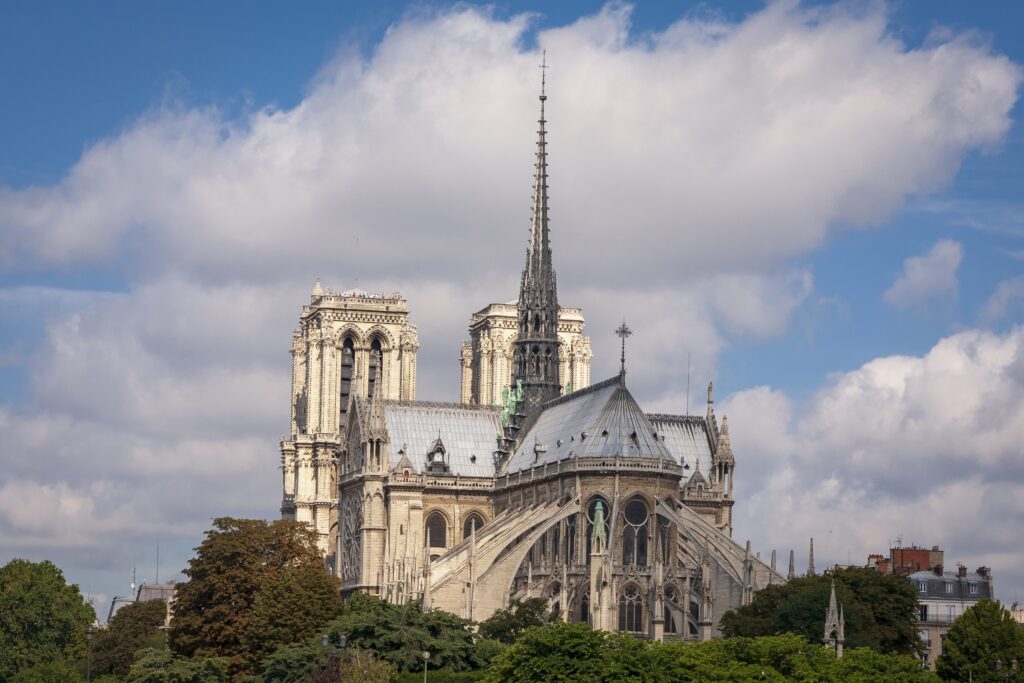
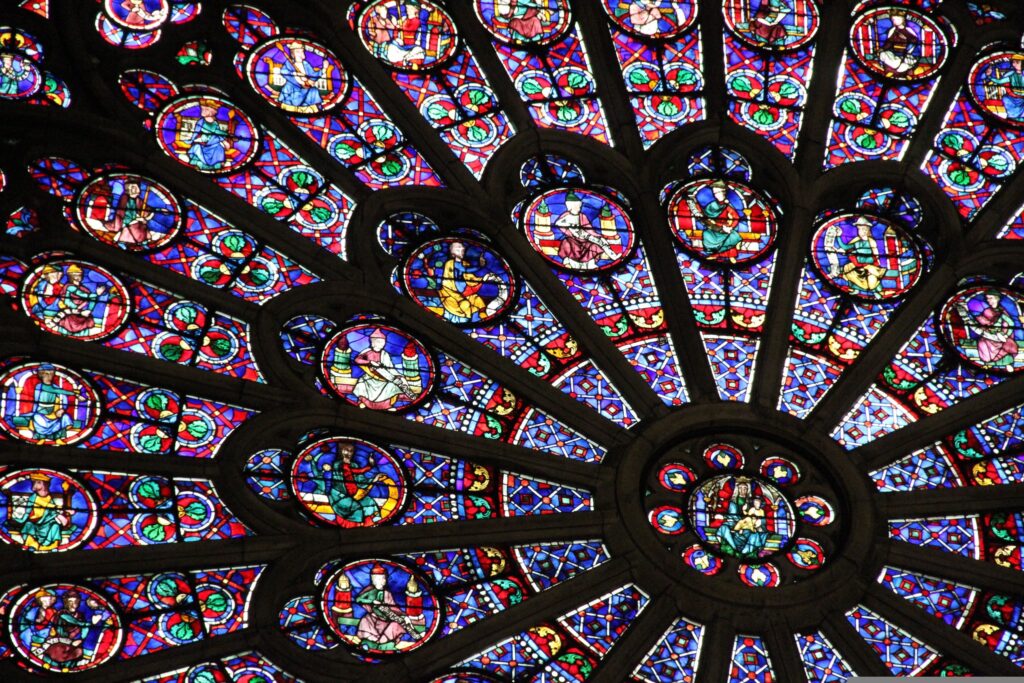
Thank goodness that here in Paris, my walk at the moment was solitary. This way, I didn’t have Barbie pacing me, hair-flipping her way along the Seine on the way to Notre Dame. The landmark medieval cathedral would be reopening this very day after its five-year restoration following the 2019 fire that destroyed its spire and roof and radically damaged its interior. Though the altar, two pipe organs, and three 13th century rose windows survived and many works of art and religious relics spared, the flames and smoke had contaminated the cathedral’s home on the Île de la Cité and nearby Paris areas with toxic dust and lead. The stunning resurrection, involving thousands of artisans, engineers, carpenters, and craftspeople was a bit like the Camino’s flapping, squawking cockerel: a miracle. I had to see it.
I had to see it also because, according to the 12th century Codex Calixtinus, Notre Dame historically was one of four main gathering points for Camino pilgrims setting out from Paris along the Via Turonesis, an acknowledged route. The Codex, dating from the late 1130s, is an anthology of sermons, liturgical texts, musical pieces, and reports of miracles associated with Saint James; it was intended to be a travelguide for medieval pilgrims following the Way of Saint James to the shrine dedicated to him at Santiago de Compostela, and included helpful maps, must-see works of art, and even notes on the customs of the locals. Hope it advised these travelers to forget finding anything to eat that is ham free! The Via Turonesis officially begins at the Church of Saint Jacques, mere blocks from Notre Dame, but never mind: today’s Camino trekkers typically get their pilgrim passports’ first stamp at Notre Dame instead. Carried in pocket or backpack like the ubiquitous scallop shell – symbol of the Camino – these little booklets are marked along the Way with each town’s unique seal, so a stamped-full passport upon arrival at the Santiago cathedral is a souvenir that proves, I did it! Stepping onto the Via Turonesis, an approved Camino route, and asking for a stamp at Notre Dame would make my current detour with kitty feel less errant, more on the mark.
So, I snuck out of our studio, where Camino was splashing about in the shower’s puddles – he was a real water-puss – and fairly danced in the direction of the Seine. Paris! The November day was crisp and misty and Parisians were bustling along the boulevards with purpose. The scent of espresso wafting from cafés; the London plane trees of the Champs-Élysées lit for the season in a spectacle of lights; the miles to go before I would arrive: walking in the City of Light was my heart’s highest delight, so I, too, bustled. At the same time, give or take a few years, there was W. Lee Nichols definitely not bustling, but moving nonetheless along the Camino, serenading his steps with deep thoughts:
Throughout the millennia (he muses), humans have walked on great pilgrimages such as during the Crusades to Jerusalem or Santiago, to the sacred Ganges in India, or Mecca in Saudi Arabia. For over a thousand years hermits wandered the earth on foot in search of their gods. Longer still, nomadic tribes have carried the seeds of their culture and earth-teachings to every corner of our planet. And they did it walking.
“My pilgrimage has taught me,” he reflects, the moment he spies the spires of the Cathedral in Santiago and, after sixty days of trekking, realizes he soon will arrive at his journey’s end, “that once we take our position in the flow of the universe, we are held aloft by its sheer energy and rewarded with its warm embrace of love, wisdom, and guidance.” Well, I wasn’t yet feeling the love that the flow of foot traffic along the Seine – direction Notre Dame – probably promised, but oh, the energy! Walking block upon block in the chill, what looked like the entire world was hoofing it along the river quais with me, all of us with great excitement. To my ear every possible language was represented in the blabbing, laughing throngs, and the continual pierce of police sirens merely amped up the mood when car after car, bomb squad after bomb squad, SWAT team after SWAT team sped by. That evening presidents, princes, priests, and potentates would gather inside the cathedral to celebrate its reopening with Psalm-singing, organ-blessing, and a heartfelt thank-you to the 160 firefighters who had heroically battled the blaze. Pope Francis had sent a message “of joy” to be read, and with much pomp and musical performances by such luminaries as cellist Yo-Yo Ma, the Archbishop of Paris would preside over a service that featured, because this was fashion-forward Paris, priests arrayed in snazzy liturgical vestments designed by Jean-Charles de Castelbajac. Past the Pont de l’Alma tunnel where Princess Diana died; past the Grand Palais, transformed for the holidays into France’s largest indoor ice rink; past the Place de la Concorde, where during the French Revolution King Louis XVI and Queen Marie Antoinette lost their heads to the guillotine; past the stunning Tuileries gardens and the Louvre: I (and the rest of the world of high-spirited bustlers) at last arrived within sight of Notre Dame.
“Madame! Monsieur! Monsieur! Madame! S’il vous plait!” A gendarme of movie-star looks was crowd-managing the throngs packed tightly together who agitated for access to the cathedral. With all the suave he possessed he fought off anyone – everyone – who did not have a private invitation in hand, and really, it didn’t matter if you were from Prague or Pittsburg, St. Petersburg or São Paulo, if you weren’t a president, prince, priest, or potentate, you were not getting past the rope that Officer Handsome manned.
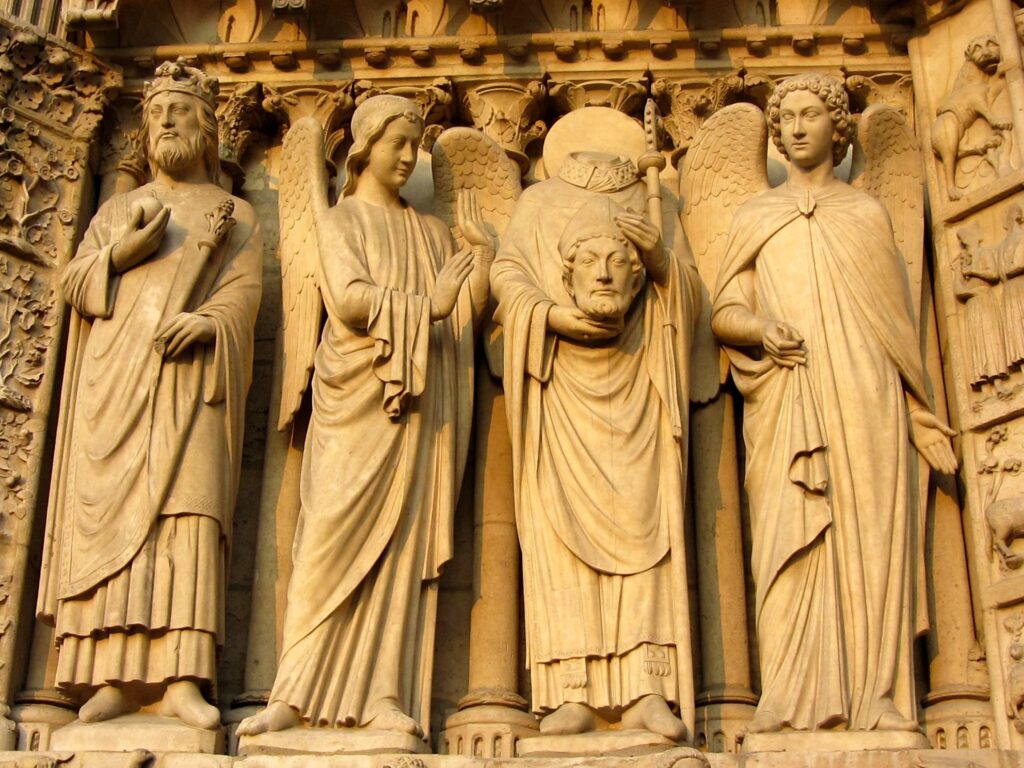
In just a few hours, the world’s beloved Notre Dame will again open its doors five years after the tragic fire… Newswomen and -men stood shivering and wind-slapped before their camera crews – the frame’s backdrop the eternally standing church, with its proud, new spire topped by a golden rooster/phoenix gleaming – and spoke Spanish, Italian, Mandarin, or Polish into their microphones; folks back home all around the world were thus joining us in celebration of the occasion. Bomb squads and SWAT boats puttered to and fro in the Seine; sirens wailed of more and more police cars arriving; and Captain Attractive was given backup of a dozen gun-carrying hunks that included a bevy of badass women. It was obvious: right here, right now, history was happening.
Shivering and wind-slapped myself as I leaned against the low stone wall of the Quai de l’Hôtel de Ville, I gazed up at the great Gothic marvel with its gargoyles of menacing expressions, there to symbolize the fight against evil and represent the demonic forces that the church’s holy interior guards against. Candlelight from within made the stained-glass windows glow in the deepening dusk, and I didn’t mind too much not being a princess or priestess assigned a tiny wicker chair inside for the reopening spectacle: live TV soon would have the better view, so for now it was thrilling enough to stand in awe of Our Lady of Paris as she debuted her renewed beauty and flaunted her refreshed grace, and we in the mashed-together mob smiled nonstop at one another.
Recent Comments