
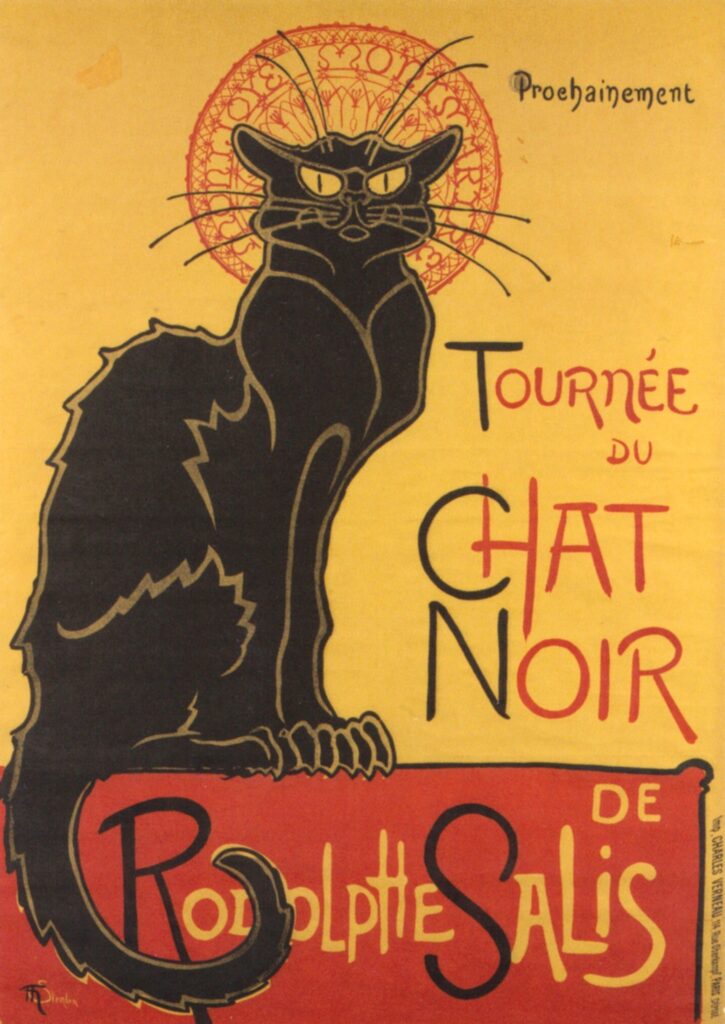
 Théophile Alexandre Steinlen (1859-1923) was an artist mad for cats. The Montmartre resident was among the gang in the Paris salons of the 1890s, showing his landscapes, still lifes and nudes, but the minute he graphically designed his most-most loved work, Tournéee du Chat Noir de Rodolphe Salis, he became the man: the guy whose poster for Le Chat Noir, a bohemian cabaret founded by impresario Rodolphe Salis, earned the world’s respect and affection. The black cat he debuted on the poster, all hard angles, wild whiskers, and gargoyle eyes became a Paris cliché, a beloved motif that appears even today on every possible tourist whatnot – tee-shirts to mouse pads, fanny packs to shot glasses. His famous feline oeuvre followed: Summer: Cat on a Balustrade (1909) with its sleek sunning tabby; À la Bodiniére (1894), where a fat, curvy calico joins a black house panther in a dignified sit; and Pierrot and the Cat (1889), in which a French toddler costumed as a clown tries to hoist a too-heavy black cat off his paws, much to the cat’s consternation. These and other colorful illustrations helped make the cat synonymous with Paris.
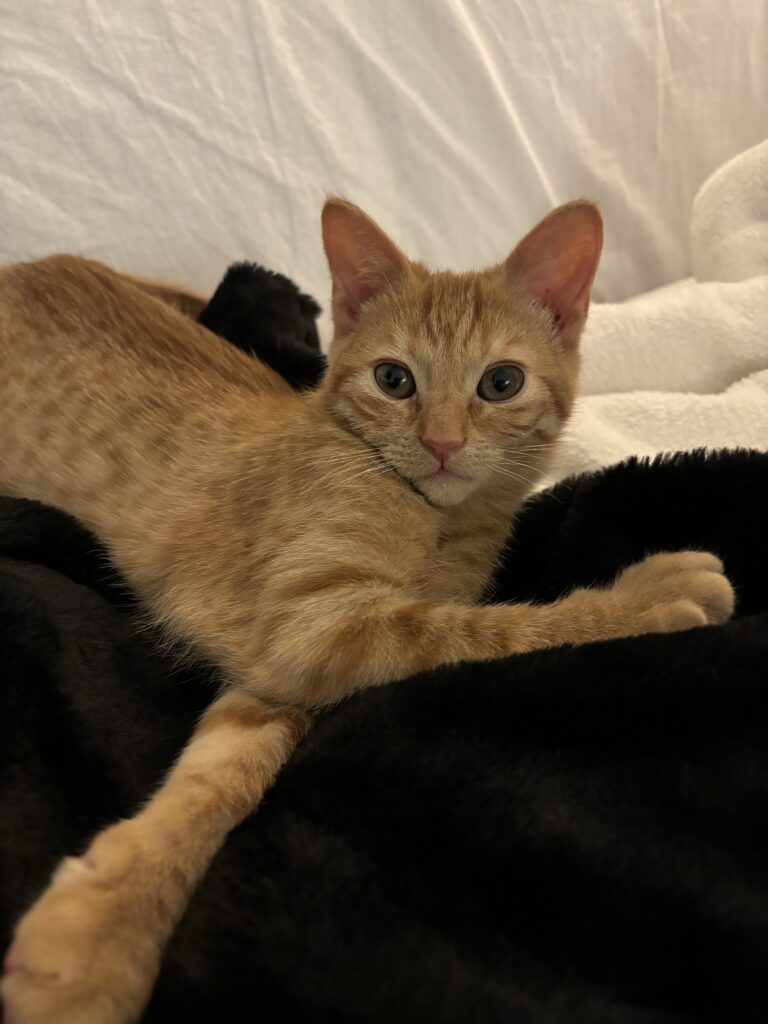
Camille and Jacqueline had flown home that morning, so Camino and I were alone in our Avenue Kléber studio-with-garden-view. The following day was his all-important vet appointment, where he would receive the first vaccinations required for his French passport. So, to take his mind off the upcoming métro ride with its chaos and noise (so frightening!) and, worse, veterinarian ready with injections (painful!), I chatted him up about how he, though Spanish, was now living in the City of Light: where he definitely belonged.
“Do you realize, my kitten, just how much you are revered here?” He lay in my lap listening, though he seemed sad, even depressed that he couldn’t air his grievances or express his fears or share his personal triumphs without cat-whisperer Camille around to hear them. “Since the dawn of time in Paris, cats have been beloved, adored, respected, and honored in many, many Parisians’ lives.” Camino gazed at me, like, so? “So, my kitten, cheer up! With enough time here, you, too, can come to feel like a Parisian kitty. Wouldn’t you like that? To know such adulation?” Naturally, I wasn’t in the least suggesting he forsake his heritage rooted in Spain! “Of course, you’re still Spanish,” I assured him so as not to break his tender Zorro heart a’flame with feline passion, the very essence born in him on the sacred Way of Santiago. “But why not let Paris show you how you can become the cat – lord of the home and beholden to none?”
Camino thought that sounded good. He blinked his gold eyes slowly in assent and let escape a sigh of small purrs. He obviously was asking for a naptime story, so I began: Once upon a time… I told him of historical Paris people like Cardinal Richilieu, who loved Persian-cats and Angora-cats so much he owned 14 of them at his death, and the poet Charles Baudelaire, so wild about felines he dedicated his Le Fleur de Mai to them. I told him of modern-day cats like Félicette, who in 1963 was the first black-and-white stray to survive a trip to space, and the beautiful Maine Coon who co-starred with Audrey Hepburn in Gigi. I even shared the spellbinding tale of Paris’s current cat cafes – Le Café des Chats and the Cat Mallows Café; there, felines are so fancied that worshippers line up for the chance to dine with them in their laps. Oh, and let’s not forget Karl Lagerfeld – the House of Chanel! – who shared a lavish lifestyle with his muse and constant companion, the elegant, blue-cream Birman-cat christened Choupette. Camino was fast asleep by now, but I went on: Of course, wildcats by the dozens dwelled in the city’s cemeteries, like Père Lachaise and Cimetière de Montmartre, but did Parisians find this appalling? No! Along with the graves of Stendhal and Zola, they cared for them, with respect and affection.
“Do you see, my kitty Camino, that if you were to feel like a French cat, you too could rule the people of Paris. Yes,” I had to be frank with him, “you are orange, and you hail from the land of the flamenco and paella, but you surely still can siesta here without fear of being thought odd.” At odd the kitten’s eyes jerked open; he was again awake and, siesta over, bolted behind the tiny bureau. Thus hidden, I could hear his thoughts: You don’t see me now, Señorita, but be assured: I shall avenge any dishonor brought upon me if you dare make me pretend to be French! Well, I didn’t want any more marks of Camino carved upon my tender flesh by the blades of his claws, so okay, okay: “It’s okay, my kitten,” I called to him in a conciliatory tone. “I promise not to try and civilize you into a feathery Angora. I know I know: no rhinestone collar for you!” I had to let my wild child from the Camino be, with his Zorro pretentions, the cat he was born to be.
_________________________________

Dr. Lhubert felt Camino whiskers to tail; she inspected his eyes, his ears, his teeth, his feet, and the bijoux de famille he would lose at six months. “Oh, my handsome fellow!” In heavily French-accented English the vet swooned, as all the vets did, for kitty. “He ees zee most strong bébé, no?” Oh, yes, he was indeed a fierce and feisty three-month-old who slapped me around in his efforts to play and considered our Paris studio his personal den of destruction. I had cat-proofed the place, but if it could be broken or climbed or shredded or leapt from, whatever it was, ceiling fan to sofa with fine upholstery, he was your kitten to call. He was not, however, loving Dr. Lhubert, despite her flirty flattery, and when she asked, ow ees zee kitty’s toilette?…well, I was afraid to say. The truth was, he’d had a bout of diarrhea the day Camille and Jacqueline left; it happened in the small, safe space of his crate…in the backseat of a taxi trapped in traffic. It was the worst: his first and only accident and for Camino, proud son of Spain, where the legend of history’s mighty conquistador – soldier, explorer, adventurer – held sway, it was a humiliating loss of dignity. He had meowed with all the rage and shame as befits such a blow to his self-image, and it took a day or two for him to regain his kitty-confidence. “Alors, zee toilette?” Dr. Lhubert waited while I stammered, stuttered, stalled, and then finally was out with it: the diarrhea event.
“Ah, I see. And zee cuisine? What is ze food kitty eat to maybe make ze diarrhée?”
“Bugles,” I blurted.
“Bugles?” Dr. Lhubert seemed to mishear.
“And nacho-cheese Doritos.”
“What ees zis, ‘Bugles’ and ‘nacho-cheese’?”
It was hopeless. I couldn’t pretend to be the most competent cat-mom when clearly, Dr. Lhubert was calling me out for my reckless care of Camino, who was about to suffer an insult way more traumatic than that in the taxi. With a hypodermic needle that looked more like a bike-tire pump, she injected my baby in the jugular with a chip to ensure if he ever got lost in Europe, he could be returned to her; I had no permanent French address, she said, so this was best, and – ees ze best! – I could simply return to Paris to get him. Kitty let out a yowl-shriek-scream that was unearthly. Surprise, shock, pain: no conquistador who colonized the Americas, Africa, and Asia in the 15th through 17th centuries met with such torment. After two more shots – his first vaccinations – Camino was returned to his crate, where he curled up in the farthest corner and radiated hate. Dr. Lhubert turned to me.
With the sweetest and most sincere of tones, she said: “Camino, oh! He ees strong and oh! So beau…handsome: he ees handsome.”
“Yes, he is quite the little Don Juan.” I then babbled about how my friend Gina and I found him on the Camino de Santiago when he was only three weeks old and very sick, and about how I was staying in France with him for four months, to have him old enough for Air France to clear him for take-off home. Dr. Lhubert smiled at my story but then suddenly sobered up.
“Ze Bugle. Ees not cat food, no?”
“No,” I admitted in a tiny, mouse-voice. “It’s junk food. From America. Very bad.”
“Ah, I see.” She looked over her chic Parisian glasses at me, and her gorgeous green eyes shone with care and concern for her four-pawed patients. “Do you want bébé Camino to become obèse?”
“Obese? No!” I imagined him as a big orange chonker, obsessed with Doritos, a laze-about and diabetic.
“Or seek?”
“Ohmygosh.” My mouse-voice got weaker – an even meeker squeak. A chronically sick kitty needing vet visits costing thousands? I just couldn’t. Why did I let Camille show him so much fun? “No, no. I don’t want that.”
“Bon, alors.” Dr. Lhubert, being French, was one-hundred percent culturally schooled in the custom of beautiful meals, beautifully prepared from beautiful ingredients. She didn’t say Camino would be better off eating real butter (so beautiful!) and a baguette fresh from the boulangerie (a most beautiful thing), but she was very, very clear: “No more of ze junk food, please. Only ze cuisine for ze cat.”
“Oui, Madame le Docteur. Merci.”
How now to not further crush his spirit?
Recent Comments